
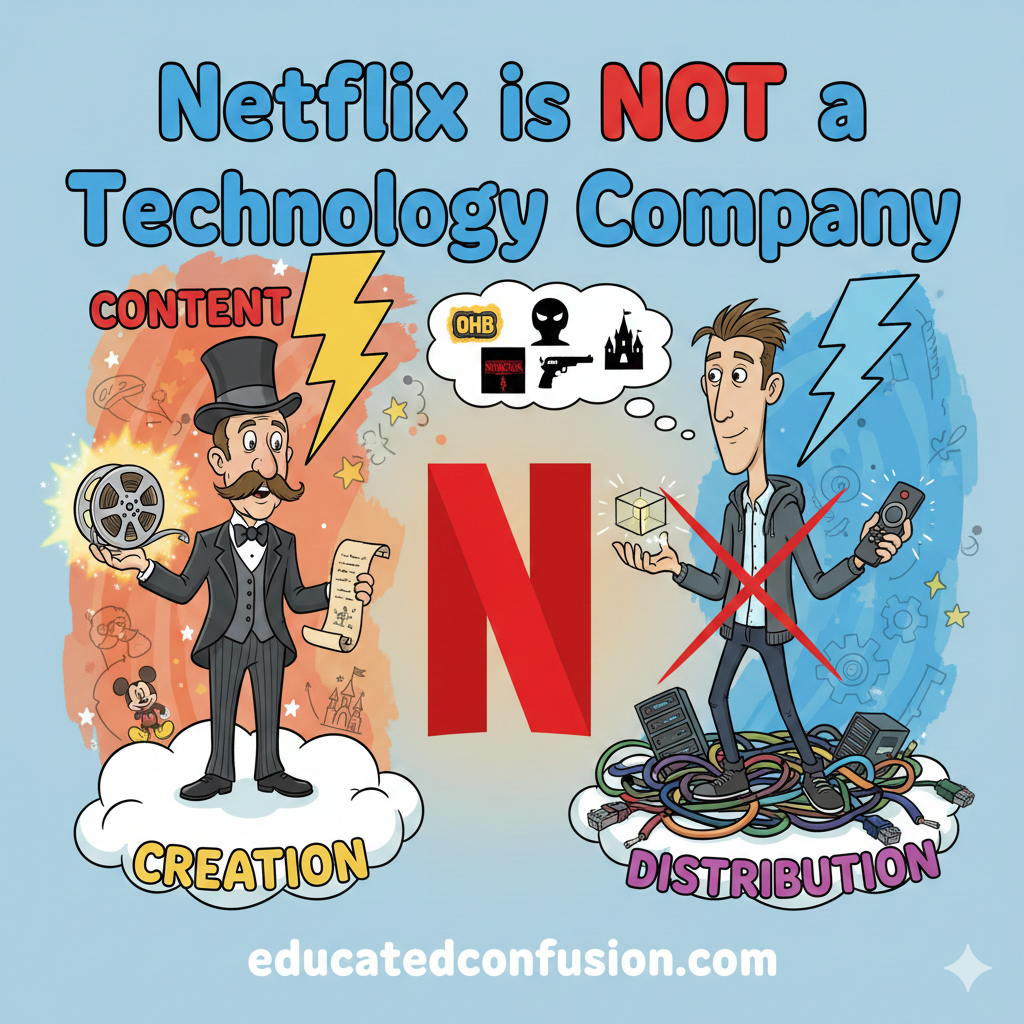
The other day, I was walking through a certain Florida theme park—a place built on the legacy of a man who invented beloved characters and vertically integrated his creative vision—when my daughter, Mary, said, “I wish this was Netflix World.” She was quietly humming a song from her latest obsession, K-Pop Demon Hunter. It was mind blowing for somebody who grew up with Mickey Mouse, Daffy Duck, and Disney as a cultural powerhouse. There are people who dream of working at Disney, even as a character in one of the the amusement parks. They’re famous for their story telling…
And yet…. my child, immersed in the physical world of Disney, was yearning for the digital, global ecosystem of Netflix. This feeling, that Netflix is the new cultural phenomenon, is exactly why we need to address a persistent piece of industry miscategorization: the idea that Netflix is a technology company.
It’s not. Technology is merely an enabler for its true business: media and content creation.
For a deeper dive into my thinking on this, you can review my earlier article on this topic: Read my previous thoughts on this.
The Essential Business Pivot
Let’s rewind. Before the hits like Orange is the New Black, Narcos, Stranger Things, and House of Cards, Netflix was struggling with subscribers. It was under attack from traditional cable companies and its future looked uncertain. How did the company turn the ship around?
They started producing their own content.
And let’s be crystal clear: software engineering at Netflix did not make that decision. This was a quintessential “business decision.” It was a decision to create value for their market—people who watch content through the Internet. They were a content distributor, and they decided to enter an adjacent market: content creation. This move was a stroke of strategic genius, and execution. But, lets be clear, it was not code that drove it.
The Technology Wizard Myth
Time and again, Netflix is referenced as some kind of “technology wizard,” lauded for contributing to the OSS (Open Source Software) stack, moving almost everything to the cloud, and hiring only the best and the brightest engineers (a trope that has annoyed me for a decade). No, their contributions to open source and dedication to technology are a way to attract and retain talent. That’s a real business problem, but it doesn’t drive new revenue.
They are rightly held in high regard for “disrupting” the cable industry—but for the wrong reasons. It’s not their technology that is their differentiated value proposition to the market. It is their cunning move to create content akin to HBO. This content created a flywheel, placing them in a stronger position to negotiate better contracts for their distribution business while simultaneously locking in subscribers who could only watch Narcos on one platform.
I would argue that they have succeeded, not because of their technology, but despite it. Their end-user experience is often rather lacking, yet they keep attracting and retaining subscribers. This retention is a testament to the irresistible nature of their content catalog, which overrides any friction the user might encounter.
The Subpar User Experience
If Netflix were a world-class technology company, its product would be universally recognized for its superior user experience (UX). Yet, several long-standing issues reveal that the content, not the application, is the star:
-
Late Adoption of Offline Downloads: They finally, just recently, added the ability to download movies and watch them offline. Even now, not all content can be downloaded, even some they produced, which makes no sense to me. Google Play and Amazon Prime have had this since almost the beginning of their service, yet nobody hails them as great innovators.
-
Clunky Playback Controls: It takes forever when you rewind or fast-forward. Again, Google Play and Amazon Prime both have smoother, better experiences.
-
Subtitle Annoyances: Subtitles get blocked when the video is paused. This is just a really annoying flaw when the very reason you paused the video is so that you can read it slower.
These are not the hallmarks of a company whose primary focus is perfecting its software product. These are the shortcomings of a company whose internal priorities are set on funding the next massive content bet, knowing that a few seconds of buffering won’t cause millions of subscribers to churn if the next season of Stranger Things just dropped.
Conclusion: The Final Quote
The next time you hear somebody call Netflix a technology company, just quote their own CEO (Reed Hastings, on content spending):
“We spend money more like a media company than a tech company.”
The truth is, Netflix made its lightning-strike move by embracing its identity as a media company first. The cloud, the algorithms, the software—it’s all just the delivery truck for the true value: the story. And that, in the history of business, is the oldest value proposition of all.