---
# Bicycle Do
**URL:** https://educatedconfusion.com/bicycle-do/
Date: 2026-03-02
Author: fatherlinux
Post Type: post
Summary: A friend of mine lent me a book a few months ago at Angel Falls, our usual coffee spot in Akron. It’s called Taekwondo: Ancient Wisdom for the Modern Warrior by Doug Cook. He’s into martial arts, and I think he thought I’d appreciate the philosophical side of it. He was right, but maybe notContinue Reading "Bicycle Do" →
Categories: Books, Life, Physical Fitness
Tags: books, exercise, Philosophy
Featured Image: https://educatedconfusion.com/wp-content/uploads/2026/03/bicycle-do-thumbnail.png
---
A friend of mine lent me a book a few months ago at Angel Falls, our usual coffee spot in Akron. It’s called *Taekwondo: Ancient Wisdom for the Modern Warrior* by Doug Cook. He’s into martial arts, and I think he thought I’d appreciate the philosophical side of it. He was right, but maybe not for the reasons he expected.
I don’t practice taekwondo. I ride bikes. Specifically, I ride dirt jumpers and BMX at Ray’s Indoor Mountain Bike Park in Cleveland. I’ve been riding there for about three seasons now, two to four times a week, and somewhere along the way it stopped being exercise and started being something else. I didn’t have a word for it until I reviewed this book.
The word is *Do*.
## The Way
In Korean, the word “Do” means “the Way.” It’s the same character as the Japanese “do” in judo and aikido, and the Chinese “tao” in Taoism. It’s the last syllable of taekwon-*do*, and according to Cook, it’s the whole point of the art. Taekwondo isn’t just a set of kicks and punches, it’s a philosophical system for living. The physical practice is inseparable from the mental and spiritual discipline that comes with it.
When I read that, I immediately thought of the riders I know at Ray’s. The really good ones, the ones who make it look effortless, are obsessed with this thing. It’s not a hobby for them, and it’s definitely not a workout. It’s a way of life. They think about it constantly, they refine their technique endlessly, and they show up whether they feel like it or not. I think they’re practicing Do. They just call it riding.
## A House of Discipline
Cook writes about the *dojang*, the taekwondo training hall, as a sacred space. Not sacred in a religious sense, but in the sense that it has its own culture, its own etiquette, its own hierarchy. You bow when you enter. You respect the people who’ve been training longer than you. You don’t just walk in and start swinging.
Ray’s is like that. There’s an unspoken culture there that you pick up over time. You wait your turn. You respect the riders who are better than you, and you help the ones who are newer. It’s not a gym where you put in headphones and zone out on a treadmill. It’s a community with standards, and the standards matter because they’re what make the place work. I think that’s part of what drew me in, I could feel that there was something deeper going on, even from my first visit.
## The Enemy Within
One of Cook’s best chapters is about the internal obstacles to mastery. He calls them “the enemy within”, self-doubt, laziness, ego, fear of failure. His point is that no amount of physical technique can defeat these enemies. They have to be fought internally.
I think about this every time I ride. I’ve been at this for almost three years, and I’m probably what you’d call an intermediate rider. I can clear most jumps, I can ride smoothly on good days, and I’m finally learning to stand up and be more confident in the air. But the inconsistency drives me crazy. Some runs are great and I feel like I’m really progressing. Some runs, I’m tentative and tight and I know it. The difference is almost never physical, it’s mental. It’s whether I can quiet the doubt and just trust what my body already knows how to do.
The fear piece is real, too. Everyone at Ray’s has a catalog of crashes. Twisted ankles, bruises, smashed helmets. We all have these memories attached to specific features, specific jumps, specific rooms. But when you drop in, you push them out of your mind. You have to. I think Cook would call that mushin, a mind clear enough that it’s not distorted by things that already happened (more on that later).
## Measurable Goals
Cook talks about the taekwondo belt system as a framework for progressive achievement. White, yellow, green, blue, red, black, each with specific requirements, each earned through demonstrated skill. You can’t talk your way to the next belt. You have to show up and prove it.
Ray’s has its own version of this, even though nobody calls it that. The jump lines are the belt system. There’s the beginner jumps, then Micro Rhythm, then Mini Rhythm, then the Expert line, then Profile World. Each one is a step up in difficulty, and you know when you’re ready to move on because you can feel it, the current line starts to feel comfortable, almost automatic, and your eyes start wandering to the next one.
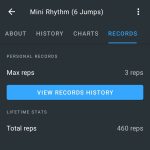
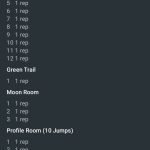
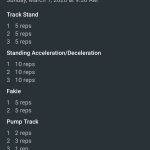
I know this because I track every session. I use a weightlifting app called Strong on my phone, but instead of logging sets of bench press, I’m logging sets of Mini Rhythm. The lifetime numbers tell the story: 1,037 reps on the beginner jumps, 360 on Micro Rhythm, 460 on Mini Rhythm. A thousand reps on the beginners before I even started feeling comfortable moving up. That’s not talent, that’s just showing up and doing the work, over and over, until the line stops scaring you and starts feeling like home.
[](https://educatedconfusion.com/wp-content/uploads/2026/03/Screenshot_20260301_214634.jpg)
[](https://educatedconfusion.com/wp-content/uploads/2026/03/Screenshot_20260301_214620.jpg)
[](https://educatedconfusion.com/wp-content/uploads/2026/03/Screenshot_20260301_214607.jpg)
[](https://educatedconfusion.com/wp-content/uploads/2026/03/Screenshot_20260301_214540.jpg)
[](https://educatedconfusion.com/wp-content/uploads/2026/03/Screenshot_20260301_214452.jpg)
There’s something about logging each set after a run that grounds you. Even on a rough day, you pull out your phone, tap the reps, and watch the lifetime number tick up by one. The progress is real even when it doesn’t feel like it. I look at today’s session, 12 sets on Mini Rhythm, a couple runs through Profile Room, Moon Room, the pump track, track stands, fakies, and I can see how far I’ve come. A year ago, I was still grinding Micro Rhythm and Profile Room wasn’t even on my radar. Now it’s just part of the workout. I definitely noticed the transition while it was happening, you feel every inch of progress when you’re earning it. But the line that used to intimidate me is now just part of the day.
I’m a blue belt, if I had to place myself in taekwondo terms. Mini Rhythm is my home right now. I do ten or more sets every time I go up there. I’m starting to whip just a hair, starting to do smooth transitions, jumping side to side, starting to jump off the little shark fins on the jumps. I can clear everything on the Expert line now, but it’s inconsistent. I can feel the next level, but I’m not there yet. I think that’s actually the hardest place to be, you know enough to see how much you still don’t know.
## Poomsae
There’s a chapter in Cook’s book about poomsae, the formal patterns in taekwondo, and I think it might be the most important one. Most people who watch someone performing poomsae probably think it looks like choreography, just a sequence of kicks and blocks done in a specific order. Cook sees it completely differently. He says poomsae is where the whole art comes together, the physical technique you’ve been drilling, the mental focus, and something he calls moving meditation, where you’re so locked into the sequence that your conscious mind basically gets out of the way. He even connects the eight Taegeuk forms to the I Ching trigrams, so each form is supposed to embody a philosophical quality, like water or the mountain. It’s not just “do these kicks in this order,” it’s more like “become the quality of the mountain while you do these kicks in this order.”
[Bikes aren’t used for fighting](https://www.instagram.com/reel/DVWd_7gEwtb/?igsh=ZnQwemtnMzYwNDZ0), so there’s no sparring equivalent at Ray’s, but I think poomsae is actually the concept that fits what we do most closely. Jumps are one form, skinnies are a completely different discipline with their own progressions, and so are flatland tricks, and skate ramps. There are all these different disciplines within BMX, and each one has its own set of movements, its own way of building up from the basics. Even doing a manual is almost its own poomsae, because it’s one movement, but you can spend years refining it, finding the balance point, learning to hold it longer, getting your body quiet enough that the bike just stays under you. When I’m running Mini Rhythm for the tenth time in a session, I’m not really learning anything new, I’m refining the form. Each run is a little different, maybe I’m adjusting my pop, or working on my hip hinge, or trying to smooth out a transition between features that I’ve been chunky on.
## Mushin
Cook writes about a concept called *mushin*, which translates as “no mind.” It doesn’t mean emptiness, it means a mind so clear that it doesn’t get in its own way. He uses the metaphor of a serene pool of water reflecting the image of a full moon. When the water is still, the reflection is perfect. When it’s choppy, everything is distorted.
This is the thing that separates a good run from a bad one at Ray’s. When I’m riding well, I’m not thinking. I’m focused on cues, hinge at the hip, stay upright, look ahead, but I’m not *deliberating*. The body is executing what it’s been trained to do, and the conscious mind is just along for the ride. The rhythm is there, the timing is there, the body position is there, and it feels amazing.
When I’m riding poorly, I’m thinking too much. I’m replaying the last jump I botched, or I’m anticipating the landing instead of just being in the moment. The pool is choppy. And when the pool is choppy at Ray’s, physics is brutal. The bike doesn’t care about your feelings. It responds to inputs, and distorted inputs produce distorted results.
I think every rider at Ray’s knows this feeling, even if they’ve never heard the word mushin. It’s the difference between a smooth run and a sketchy one, and it almost always comes down to whether you could get your head out of the way.
## Indomitable Spirit
The fifth tenet of taekwondo is *Baekjul-boolgool*, indomitable spirit. The literal translation is something like “100 times broken, still not yielding.” Cook gives this tenet its own chapter. He traces it through Korean history, a country invaded by the Mongols, the Japanese, carved up by outside powers, broken over and over, and still here. Indomitable spirit isn’t an inspirational poster. It’s a survival trait.
I think about those 18 screws and two plates in my leg. I think about the three months on crutches, watching videos of guys riding at Ray’s while I couldn’t walk to the kitchen. I think about the first time I got back on a bike and how terrified I was. And then I think about how I ride now, better than before the break. Not because of some magical mental toughness, but because I refused to let that injury be the last chapter. I think that’s what Cook means by indomitable spirit. It’s not about never getting knocked down, it’s about getting back up every time.
## Total Commitment
Cook draws a line between people who “do taekwondo” and people who “are taekwondoists.” The difference, he says, is total commitment, not just showing up, but making the practice a central part of your life. It means training when it’s inconvenient, continuing when progress stalls, and not leaving when the next interesting thing comes along.
I started riding at Ray’s because my friend Nate took me up there. But I kept coming back because of something I couldn’t quite name. I think it’s the same thing Cook is describing. Somewhere between the first tentative roll through the beginner jumps and my ten-thousandth set on Mini Rhythm, I stopped being a guy who rides bikes and became a rider. I don’t know exactly when it happened, but I know it did, because now when I miss a few days, I feel it, and not in my legs. In my head.
The riders I’ve become friends with up there, they’re the same way. These aren’t casual gym-goers. They’re obsessed. They watch footage of themselves, they analyze their form, they talk about new tricks over beers. I think Cook would recognize them immediately. They’ve made total commitment, even though they’d probably laugh if you described it that way.
## Blue Belt
I’m not writing this from the top of the mountain. I’m writing it from the middle. In taekwondo terms, I’m maybe a blue belt, past the beginner excitement, past the phase where everything is new and progress comes fast, and deep into the long grind where improvement is incremental and inconsistency is the main opponent.
I can feel the rhythm when it clicks. I know what a good run feels like. But I can’t produce it on demand, not yet. Some days I clear the Expert line clean and feel like I’m finally getting somewhere. Other days I’m tight and hesitant and wondering if I’ll ever be consistent. Cook would probably tell me that this is exactly where the real training happens, not when it’s easy, but when it’s hard and you keep showing up anyway.
I ride a Kona Shonky dirt jumper, metallic green, and a Kink Gap BMX, orange. I love both bikes. I’m smoother and more confident on the dirt jumper, but I’m getting better on the BMX, slowly. The dirt jumper forgives more. The BMX demands more precision. I think riding both is making me a better rider overall, the same way Cook says basics, forms, and sparring are all necessary legs of the stool.
## Bicycle Do
Cook’s whole book builds to a single idea: the word *Do*. The Way. Taekwondo isn’t something you do at the training hall three times a week. It’s a lens through which you see everything, how you treat people, how you handle adversity, how you manage yourself. When the principles become reflexive rather than recited, you’re living the Do.
I think there’s a Bicycle Do. I think the riders at Ray’s who are truly obsessed with the art form, and it is an art form, are living it. They just don’t have a Korean word for it. It’s the discipline of showing up, the humility of being a permanent student, the courage to try things that scare you, and the stubbornness to come back after getting broken. It’s that pursuit of the moment when the rhythm clicks and the conscious mind goes quiet and the bike just flows.
[gallery ids="2393,2394"]
And Dan, if you’re reading this, thank you for the book! Also, to Allen, you were my Sabumnim (사범님), the Korean term for a master instructor 😉 Also, I need to find a new Sabumnim, sigh 🙂
---
## Categories
- Books
- Life
- Physical Fitness
---
## Navigation
- [Education](https://educatedconfusion.com/education/)
- [Confusion](https://educatedconfusion.com/confusion/)
- [Home](https://educatedconfusion.com)
- [Confusion](https://educatedconfusion.com/category/confusion/)
- [Books](https://educatedconfusion.com/category/confusion/books/)
## Tags
- books
- exercise
- Philosophy